Half adder
A half adder adds two single bits and produces a two-bit result: a sum bit and a carry bit. It is the smallest useful arithmetic circuit and the building block of every adder on the following pages. This page walks through its SHDL source, the Base SHDL the flattener turns it into, and a Python session that checks every input combination.
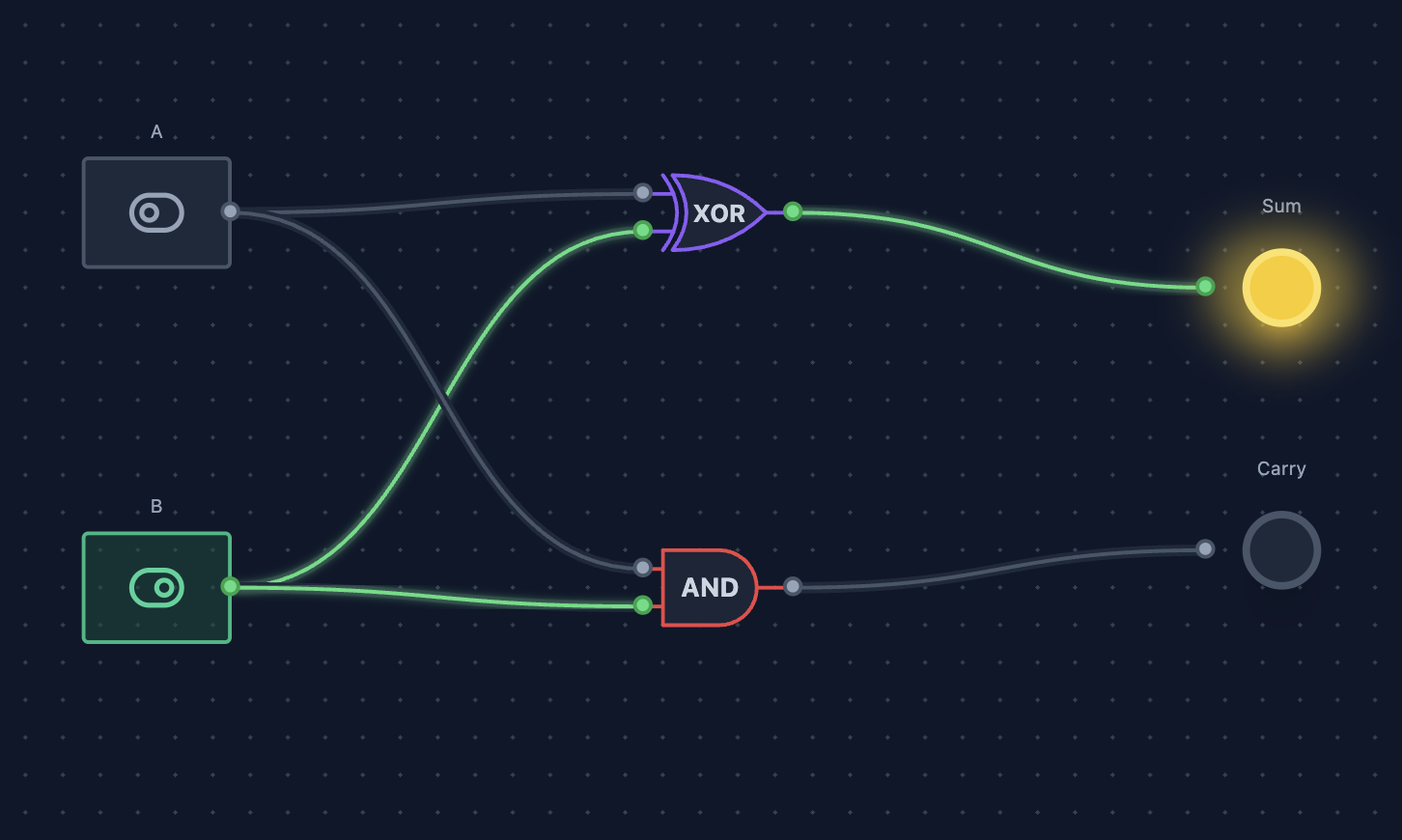
What it computes
| A | B | Sum | Carry | A + B |
|---|---|---|---|---|
| 0 | 0 | 0 | 0 | 0 |
| 0 | 1 | 1 | 0 | 1 |
| 1 | 0 | 1 | 0 | 1 |
| 1 | 1 | 0 | 1 | 2 |
Sum is 1 when exactly one input is 1, which is XOR. Carry is 1 only when
both inputs are 1, which is AND. Read Carry Sum as a two-bit binary number and
you get A + B.
Source
The half adder is defined in
examples/fullAdder.shdl,
next to the full adder that is built from it. Here it is on
its own, exactly as written there:
component HalfAdder(A, B) -> (Sum, Carry) {
    x1: XOR;  a1: AND;

    connect {
        A -> x1.A;  B -> x1.B;  x1.O -> Sum;
        A -> a1.A;  B -> a1.B;  a1.O -> Carry;
    }
}
Line by line:
component HalfAdder(A, B) -> (Sum, Carry)declares a component with two single-bit inputs and two single-bit outputs. Inputs go in the first parenthesised list and outputs after->. See Components.x1: XOR; a1: AND;declares two instances of primitive gates. Every primitive has inputsAandB(onlyAforNOT) and outputO. Several declarations can share a line. See Standard gates.connect { ... }holds the wiring. Eachsource -> destination;statement drives one signal from another. A component input (A) can fan out to as many gate inputs as you like, and a gate output (x1.O) can drive a component output (Sum). See Connections.
The file has only one component, so the flattener picks it as the top
automatically. No top marker is needed.
Flattened netlist
shdl-flatten turns SHDL into Base SHDL: a flat list of primitive gates, one
connection per line, followed by a meta block of JSON metadata. The
--timestamp flag pins the flattened_at field so the output is reproducible.
$ shdl-flatten halfAdder.shdl --timestamp 2026-01-01T00:00:00Z
component HalfAdder(A, B) -> (Sum, Carry) {
    x1: XOR;
    a1: AND;

    connect {
        A -> x1.A;
        B -> x1.B;
        x1.O -> Sum;
        A -> a1.A;
        B -> a1.B;
        a1.O -> Carry;
    }
}

meta {
  "version": "2.0",
  "ports": {
    "inputs": {
      "A": [
        "A"
      ],
      "B": [
        "B"
      ]
    },
    "outputs": {
      "Sum": [
        "Sum"
      ],
      "Carry": [
        "Carry"
      ]
    }
  },
  "hierarchy": {
    "HalfAdder": {
      "source_file": "halfAdder.shdl",
      "source_line": 1,
      "instances": {
        "x1": {
          "type": "XOR",
          "gate": "x1"
        },
        "a1": {
          "type": "AND",
          "gate": "a1"
        }
      }
    }
  },
  "source_map": {
    "gates": {
      "x1": {
        "file": "halfAdder.shdl",
        "line": 2,
        "column": 5
      },
      "a1": {
        "file": "halfAdder.shdl",
        "line": 2,
        "column": 15
      }
    },
    "lines": {
      "halfAdder.shdl": {
        "2": [
          "x1",
          "a1"
        ]
      }
    }
  },
  "constants": {},
  "timing": {
    "max_depth": 1,
    "output_depths": {
      "Sum": 1,
      "Carry": 1
    },
    "is_combinational": true,
    "has_feedback": false,
    "critical_path": [
      "A",
      "x1",
      "Sum"
    ]
  },
  "monitors": {},
  "stats": {
    "total_gates": 2,
    "total_connections": 6,
    "total_ports": 4,
    "by_type": {
      "XOR": 1,
      "AND": 1
    }
  },
  "doc": {
    "source": "halfAdder.shdl",
    "flattened_at": "2026-01-01T00:00:00Z"
  },
  "init": {}
}
A half adder is already flat, so the netlist is the source with one statement per line. The metadata matters more on bigger circuits, but even here it records the numbers that drive simulation:
| Property | Value | Meaning |
|---|---|---|
| Gates | 2 (1 XOR, 1 AND) | stats.total_gates and stats.by_type |
max_depth | 1 | the longest input-to-output path passes through one gate |
| Critical path | A, x1, Sum | one path of that length (a1 to Carry has the same depth) |
is_combinational | true | no feedback, so settle() is allowed |
The Base SHDL page describes every metadata field. The shdl-flatten page covers the command's options.
Flattening the real file gives the same netlist:
shdl-flatten examples/fullAdder.shdl --top HalfAdder. Only the source
locations and the doc block change, because they then point into
fullAdder.shdl.
Simulate it
Circuit flattens, compiles and loads the module in
one call. The loop below drives all four input combinations. settle() advances
the circuit max_depth cycles (here, one), which is enough for every output to
reflect the new inputs.
from SHDL import Circuit

with Circuit("halfAdder.shdl") as c:
    print(c)
    print("max_depth:", c.timing.max_depth)
    print("A B | Sum Carry")
    for a in (0, 1):
        for b in (0, 1):
            c["A"] = a
            c["B"] = b
            c.settle()
            print(f"{a} {b} |  {c['Sum']}    {c['Carry']}")
<SHDL.Circuit 'HalfAdder' (A, B) -> (Sum, Carry)>
max_depth: 1
A B | Sum Carry
0 0 |  0    0
0 1 |  1    0
1 0 |  1    0
1 1 |  0    1
The simulator uses the unit-delay model:
every gate takes exactly one cycle to respond to its inputs, and the whole
circuit powers on with every gate output at 0. poke only records the new
input values; step(1) then evaluates every gate once:
from SHDL import Circuit

with Circuit("halfAdder.shdl") as c:
    c.poke("A", 1)
    c.poke("B", 1)
    print("inputs:", c.peek("A"), c.peek("B"))
    c.step(1)
    print("after 1 cycle: Sum =", c.peek("Sum"), " Carry =", c.peek("Carry"))
inputs: 1 1
after 1 cycle: Sum = 0  Carry = 1
Reading an output right after a poke, without stepping, runs the one pending
cycle for you. That is enough for a depth-1 circuit like this one, but it is
only ever one cycle: deeper circuits need settle() or step(n), as the
full adder shows.
For many input vectors, run_batch drives them all in one call into the
compiled library. Each frame is applied, the circuit advances cycles cycles,
and every output is recorded:
from SHDL import Circuit

with Circuit("halfAdder.shdl") as c:
    frames = [{"A": a, "B": b} for a in (0, 1) for b in (0, 1)]
    rows = c.run_batch(frames, cycles=c.timing.max_depth)
    for frame, row in zip(frames, rows):
        print(frame, "->", row)
        assert row["Sum"] + 2 * row["Carry"] == frame["A"] + frame["B"]
{'A': 0, 'B': 0} -> {'Sum': 0, 'Carry': 0}
{'A': 0, 'B': 1} -> {'Sum': 1, 'Carry': 0}
{'A': 1, 'B': 0} -> {'Sum': 1, 'Carry': 0}
{'A': 1, 'B': 1} -> {'Sum': 0, 'Carry': 1}
Next
The full adder chains two half adders with an OR gate to add a third bit, the carry in.